What is an RO Plant? A Complete Guide to Reverse Osmosis Water Purification
Access to clean and safe water is essential for healthy living and efficient industrial operations. Unfortunately, water sources in many parts of Pakistan contain high levels of dissolved salts, bacteria, viruses, heavy metals, chemicals, and other contaminants that make the water unsafe for drinking and various industrial applications. This is where a Reverse Osmosis (RO) Plant plays an important role.
An RO Plant is a water purification system that uses advanced filtration technology to remove impurities, dissolved solids, harmful microorganisms, and unwanted chemicals from water. It produces clean, fresh, and safe water suitable for drinking, food processing, pharmaceutical production, commercial use, and industrial manufacturing.
What Does RO Stand For?
RO stands for Reverse Osmosis, a water purification process that forces water through a specially designed semi-permeable membrane under pressure. The membrane allows only water molecules to pass while blocking dissolved salts, bacteria, viruses, heavy metals, and other contaminants.
This process significantly improves water quality by reducing Total Dissolved Solids (TDS), unpleasant taste, odor, and harmful impurities.
How Does an RO Plant Work?
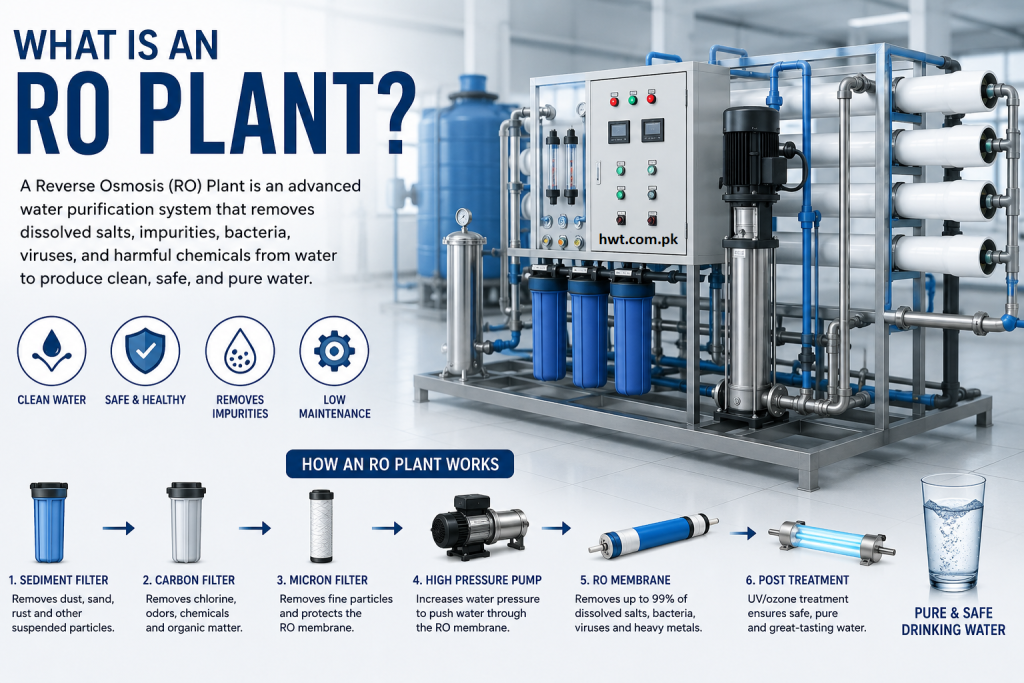
A Reverse Osmosis Plant treats water through multiple purification stages. Each stage removes different types of contaminants to ensure high-quality purified water.
1. Sediment Filtration
The first stage removes dust, sand, rust, mud, and other suspended particles. This protects the remaining filters and extends the life of the RO membrane.
2. Activated Carbon Filtration
Water then passes through activated carbon filters that absorb chlorine, pesticides, organic compounds, bad taste, and unpleasant odors. Removing chlorine is important because it can damage the RO membrane.
3. Micron Cartridge Filtration
A fine cartridge filter removes very small suspended particles before water reaches the RO membrane.
4. High-Pressure Pump
The pump increases water pressure, allowing water to pass through the semi-permeable RO membrane efficiently.
5. Reverse Osmosis Membrane
This is the heart of the system. The membrane removes up to 99% of dissolved salts, heavy metals, bacteria, viruses, fluoride, arsenic, nitrates, and many other harmful contaminants.
6. Post Treatment
Depending on the application, the purified water may pass through UV sterilization, ozone treatment, or mineral cartridges to improve microbiological safety and enhance taste.
Main Components of an RO Plant
A complete Reverse Osmosis Plant generally includes:
- Feed Water Pump
- Multi-Media Sand Filter
- Activated Carbon Filter
- Water Softener (when required)
- Micron Cartridge Filter
- High Pressure Pump
- RO Membranes
- Membrane Pressure Vessels
- Flow Meters
- Pressure Gauges
- Control Panel
- Chemical Dosing System
- Storage Tank
- UV Sterilizer (optional)
- Ozone Generator (optional)
The exact configuration depends on the water source and the intended application.
Types of RO Plants
Different applications require different system capacities and designs.
Domestic RO Plants
Designed for homes and small offices, these compact systems provide clean and safe drinking water for everyday use.
Commercial RO Plants
Commercial systems are suitable for restaurants, hotels, schools, hospitals, offices, cafés, and other businesses that require a continuous supply of purified water.
Industrial RO Plants
Industrial RO Plants are built for large-scale water treatment in pharmaceutical industries, textile mills, food and beverage factories, power plants, laboratories, chemical processing units, and manufacturing facilities. These systems are customized to handle high water demand and specific process requirements.
Benefits of an RO Plant
Installing an RO Plant offers many advantages, including:
- Removes dissolved salts and high TDS
- Eliminates bacteria and viruses
- Reduces heavy metals such as lead and arsenic
- Improves taste, odor, and clarity of water
- Protects equipment from scale formation
- Produces water suitable for drinking and industrial processes
- Reduces dependence on bottled water
- Provides a reliable supply of purified water
Where Are RO Plants Used?
Reverse Osmosis Plants are widely used in:
- Residential homes
- Offices
- Schools and colleges
- Hospitals and clinics
- Hotels and restaurants
- Pharmaceutical industries
- Food and beverage processing
- Textile industries
- Laboratories
- Mineral water plants
- Manufacturing industries
- Commercial buildings
Their versatility makes them one of the most effective water treatment solutions available today.
How to Choose the Right RO Plant
Selecting the right RO Plant depends on several important factors:
- Source water quality
- TDS level
- Daily water consumption
- Required production capacity
- Available installation space
- Water pressure
- Budget
- Future expansion plans
A professional water analysis helps determine the most suitable system and ensures efficient operation.
Maintenance of an RO Plant
Regular maintenance is essential for maintaining water quality and extending the life of the equipment.
Maintenance typically includes:
- Replacing sediment and carbon filters
- Cleaning or replacing RO membranes when required
- Inspecting pumps and pressure gauges
- Checking water quality and TDS
- Sanitizing storage tanks
- Servicing dosing systems
- Monitoring overall system performance
Routine maintenance improves efficiency and helps prevent costly repairs.
Why Choose HWT for RO Plants?
HWT provides complete water treatment solutions for domestic, commercial, and industrial applications throughout Pakistan. Our experienced engineers design systems according to your water quality, consumption requirements, and budget.
We offer:
- Customized RO Plant solutions
- Professional installation
- High-quality water treatment components
- Genuine spare parts
- Preventive maintenance services
- Technical consultation
- Reliable after-sales support
Whether you need a compact drinking water purifier or a large industrial reverse osmosis system, HWT is committed to delivering dependable and long-lasting water treatment solutions.
Conclusion
A Reverse Osmosis Plant is one of the most reliable and efficient methods for producing clean, safe, and high-quality water. By removing dissolved salts, harmful contaminants, microorganisms, and unwanted chemicals, an RO Plant protects both human health and industrial processes.
If you are planning to install an RO Plant for your home, office, business, or industry, choosing a professionally designed system and maintaining it regularly will ensure years of dependable performance and consistently pure water.